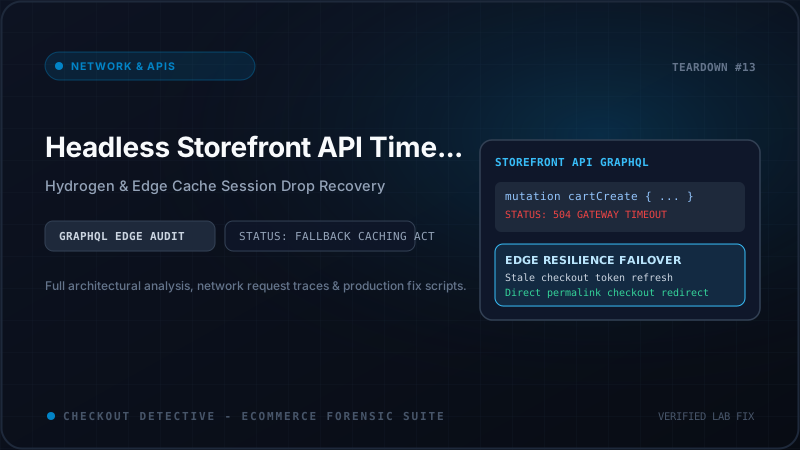
The architectural promise of headless Shopify is irresistible: sub-800ms Largest Contentful Paint (LCP), bespoke React or Svelte design systems, edge rendering on Cloudflare Workers or Vercel, and complete freedom from legacy Liquid theme constraints.
Yet for dozens of high-growth brands migrating to Shopify Hydrogen or custom Next.js 15 frontends, reality strikes during their first high-traffic flash sale. Thousands of eager shoppers add limited-edition variants to their bags and tap "Proceed to Checkout".
Instead of an instantaneous transition to Shopify's hosted checkout, the UI stalls. The button enters an infinite spinning state. In your serverless edge telemetry logs, HTTP 504 Gateway Timeout and 429 Too Many Requests errors explode. Customers who do manage to redirect arrive at a bewildering Shopify screen stating: "Your cart has expired or is no longer available."
If your brand is losing shoppers at the final conversion threshold, calculate your exact financial exposure using our Revenue Leak Calculator. In this engineering deep dive, we disassemble why Storefront API mutations stall, how cart tokens become corrupted, and how to build a resilient, production-grade checkout bridge.
The Headless Checkout Handshake Architecture
To diagnose checkout drops, you must first understand the structural difference between a native Liquid theme and a decoupled headless storefront:
[ Monolithic Liquid Architecture ]
Browser  <====== Synchronous Session Cookie ======>  Shopify Monolith Core
                                                      (Cart & Checkout in 1 DB)

---------------------------------------------------------------------------------

[ Headless Decoupled Architecture ]
Browser  <--->  Edge Runtime (Hydrogen / Next.js)  <--->  Storefront GraphQL API
                  - Encrypted Session Cookie                - cartCreate mutation
                  - Memory Cache                            - cartLinesAdd
                        |                                   - checkoutUrl resolution
                        v                                           |
           [ Customer Browser Redirect ]                            v
                        ===============================>  Shopify Hosted Checkout
                                                           (https://checkout.brand.com)
In a monolithic Dawn theme, the shopping cart and checkout engine run on the exact same database cluster, bound together by an internal session cookie managed automatically by Shopify.
In a headless storefront, your edge runtime operates as an intermediary over public HTTPS networks. The edge server must execute GraphQL mutations against Shopify's Storefront API (https://{shop}.myshopify.com/api/2026-07/graphql.json), receive an opaque Cart ID (e.g. gid://shopify/Cart/c1-8492048f0...), retrieve an ephemeral checkoutUrl, and redirect the client browser across domain boundaries.
When any link in this asynchronous chain experiences latency, rate limiting, or token invalidation, the checkout transition collapses.
Anatomy of Storefront API GraphQL Mutation Latency
Under normal catalog browsing conditions, Storefront API read queries execute with high efficiency (typically 120ms to 280ms when globally edge-routed). However, cart mutations are write operations that require ACID transaction integrity inside Shopify's core database.
Consider the canonical cartCreate mutation executed when a customer begins their checkout session:
# Lean, Production-Optimized cartCreate Mutation
mutation CreateCheckoutCart($input: CartInput!) {
  cartCreate(input: $input) {
    cart {
      id
      checkoutUrl
      totalQuantity
      cost {
        subtotalAmount {
          amount
          currencyCode
        }
      }
    }
    userErrors {
      code
      field
      message
    }
  }
}
Many headless boilerplate templates request lines → merchandise → product → images, metafields, and full variant descriptions inside the cartCreate mutation. During flash sales, serializing and deserializing massive JSON response payloads inside serverless runtimes adds 400ms to 1,200ms of unnecessary latency. Always query only the minimum fields (id, checkoutUrl, totalQuantity) required to navigate the customer.
Why High Concurrency Triggers 504 Gateway Timeouts
During flash sales or viral influencer traffic spikes, thousands of buyers attempt to reserve the same inventory simultaneously. Here is what happens behind the scenes:
- Database Row Lock Contention: When multiple
cartLinesAddmutations attempt to validate stock levels for the same limited variant inventory ID, Shopify's database engine must place row-level locks to prevent overselling. - Queue Latency Inflation: As concurrent requests stack up, mutation response times escalate from 250ms to 4,500ms, then to 12,000ms+.
- Edge Function Timeout Ceilings: Edge runtimes on Vercel Edge Functions or Cloudflare Workers operate under strict execution limits (often 10 to 15 seconds). If Shopify's Storefront API does not return before the ceiling, the edge runtime aborts the HTTP socket and returns a
504 Gateway Timeoutto the browser.
From the shopper's perspective, they clicked "Checkout", waited 15 seconds, and were greeted with an uncaught JavaScript error.
The Stale Token & Session Invalidation Trap
A frequent headache for headless architects is the Stale Cart Syndrome. A customer leaves a product in their headless cart, closes their laptop, and returns three days later to complete the purchase.
When they tap "Proceed to Checkout", the frontend attempts to read or mutate the stored cartId. If the cart has been invalidated, Shopify returns a GraphQL user error:
{
  "data": {
    "cartLinesAdd": null
  },
  "errors": [
    {
      "message": "Cart does not exist",
      "locations": [{ "line": 2, "column": 3 }],
      "path": ["cartLinesAdd"]
    }
  ]
}
If your frontend does not catch this specific error code defensively, the cart enters a zombie state: the UI shows items, but any mutation fails silently, leaving the user permanently blocked from reaching checkout.
Resilient Session & Token Freshness Handler
To prevent stale session lockups, your headless API client must implement automated cart healing. Below is a production-grade TypeScript handler suitable for Hydrogen (Oxygen) or Next.js App Router:
// lib/shopify/cart-session-handler.ts
import { cookies } from 'next/headers';

const CART_COOKIE_NAME = 'headless_cart_id';

interface StorefrontResponse {
  data?: T;
  errors?: Array<{ message: string }>;
}

export async function executeCartMutation(
  query: string,
  variables: Record,
  fallbackLines?: Array<{ merchandiseId: string; quantity: number }>
): Promise {
  const cookieStore = await cookies();
  let cartId = cookieStore.get(CART_COOKIE_NAME)?.value;

  const response = await fetch(process.env.SHOPIFY_STOREFRONT_API_URL!, {
    method: 'POST',
    headers: {
      'Content-Type': 'application/json',
      'X-Shopify-Storefront-Access-Token': process.env.SHOPIFY_STOREFRONT_TOKEN!,
      'Cache-Control': 'no-cache'
    },
    body: JSON.stringify({ query, variables: { ...variables, cartId } })
  });

  const result: StorefrontResponse = await response.json();

  // Detect Stale or Deleted Cart Token
  const isCartNotFound = result.errors?.some((e) =>
    e.message.toLowerCase().includes('cart does not exist') ||
    e.message.toLowerCase().includes('not found')
  );

  if (isCartNotFound && fallbackLines && fallbackLines.length > 0) {
    console.warn('[Checkout Bridge] Stale cart detected. Recreating cart session automatically...');

    // Transparently recreate cart with existing line items
    const newCart = await recreateCartSession(fallbackLines);
    cookieStore.set(CART_COOKIE_NAME, newCart.id, {
      path: '/',
      httpOnly: true,
      secure: process.env.NODE_ENV === 'production',
      sameSite: 'lax',
      maxAge: 60 * 60 * 24 * 7 // 7 days
    });

    return newCart as unknown as T;
  }

  if (result.errors && result.errors.length > 0) {
    throw new Error(result.errors.map((e) => e.message).join(' | '));
  }

  return result.data!;
}
Optimistic Cart Mutations & Concurrency Control
One of the most insidious bugs in headless commerce occurs when a customer rapidly taps the quantity increment button in the cart drawer.
If a customer clicks "+" three times in 400 milliseconds, a naive frontend dispatches three simultaneous asynchronous cartLinesUpdate requests to the Storefront API:
Time 0ms:    Click 1 (+) ---> Request A (Quantity = 2) dispatched
Time 150ms:  Click 2 (+) ---> Request B (Quantity = 3) dispatched
Time 300ms:  Click 3 (+) ---> Request C (Quantity = 4) dispatched

--- Network Arrival at Shopify Cluster ---
Time 380ms:  Request B arrives first ---> Quantity set to 3
Time 410ms:  Request C arrives second ---> Quantity set to 4
Time 520ms:  Request A arrives LAST (network jitter) ---> Quantity set to 2!
Because asynchronous network requests do not have guaranteed arrival ordering, the shopper watches the counter flicker: 1 → 4 → 2! Furthermore, firing multiple concurrent mutations against the same cart triggers Shopify's leaky-bucket rate limiter, returning HTTP 429 Too Many Requests.
Building an Optimistic Mutation Queue
To solve this, your client-side state architecture must decouple the optimistic UI state from the network synchronization queue:
// client/cart-concurrency-manager.ts
type PendingMutation = {
  lineId: string;
  quantity: number;
  resolve: () => void;
  reject: (err: any) => void;
};

export class ResilientCartQueue {
  private queue: PendingMutation[] = [];
  private isProcessing = false;

  public async enqueue(lineId: string, quantity: number): Promise {
    return new Promise((resolve, reject) => {
      // Coalesce existing pending mutations for the same line item
      const existing = this.queue.find((item) => item.lineId === lineId);
      if (existing) {
        existing.quantity = quantity;
        existing.resolve = resolve;
        return;
      }

      this.queue.push({ lineId, quantity, resolve, reject });
      this.processNext();
    });
  }

  private async processNext(): Promise {
    if (this.isProcessing || this.queue.length === 0) return;
    this.isProcessing = true;

    const task = this.queue.shift()!;
    try {
      await fetch('/api/cart/update', {
        method: 'POST',
        headers: { 'Content-Type': 'application/json' },
        body: JSON.stringify({ lineId: task.lineId, quantity: task.quantity })
      });
      task.resolve();
    } catch (error) {
      console.error('[CartQueue] Mutation failed, initiating rollback:', error);
      task.reject(error);
    } finally {
      this.isProcessing = false;
      this.processNext();
    }
  }
}
By debouncing and coalescing mutations into a strictly serialized queue, the user interface remains instantaneous while the Storefront API receives exactly one clean, throttled mutation.
Edge Caching Strategies: Preventing Session Leaks and Poisoning
Deploying headless frontends on edge networks like Cloudflare Workers or Fastly Compute provides sensational performance for static catalog pages. However, misconfigured edge caching around cart endpoints is catastrophic.
In 2025, our diagnostic team investigated a high-profile luxury apparel brand whose headless site was randomly showing other customers' shopping carts. The root cause? An edge caching rule configured on Cloudflare cached Storefront API responses under a shared URL without accounting for the buyerIdentity header.
| Route / Operation | Cache Policy | Cache-Control Header | Edge Risk Level |
|---|---|---|---|
| Product Details & Catalog | Edge Cache + SWR | public, max-age=60, stale-while-revalidate=300 | Low (Zero PII) |
| Cart Fetch & Updates | Strictly Private (No Cache) | private, no-cache, no-store, must-revalidate | Critical (Session Leak) |
| buyerIdentityUpdate | Bypass Cache Entirely | private, no-store, max-age=0 | Extreme (GDPR / PII Breach) |
| Checkout Redirection URL | Ephemeral (10s max) | private, no-cache | High (Stale Token) |
Enforcing Strict Edge Header Isolation
Ensure your edge worker or Next.js middleware enforces strict header barriers on any route handling cart operations:
// middleware.ts (Next.js / Cloudflare Edge)
import { NextResponse } from 'next/server';
import type { NextRequest } from 'next/server';

export function middleware(request: NextRequest) {
  // Target cart and checkout bridge endpoints
  if (request.nextUrl.pathname.startsWith('/api/cart') || request.nextUrl.pathname.startsWith('/checkout')) {
    const response = NextResponse.next();

    // Prevent any edge intermediary from caching cart state
    response.headers.set('Cache-Control', 'private, no-cache, no-store, max-age=0, must-revalidate');
    response.headers.set('Pragma', 'no-cache');
    response.headers.set('Expires', '0');
    response.headers.set('Vary', 'Cookie, Accept-Encoding');

    return response;
  }
}
The Resilient Checkout Fallback Engine (Zero-Drop Guarantee)
Even with optimized GraphQL payloads and mutation queues, what happens if Shopify's Storefront API experiences a major global degradation during a Black Friday event?
Rather than presenting your customer with a dead end, high-scale architectures implement a Direct Cart Permalink Fallback.
Shopify natively supports URL permalinks that bypass GraphQL altogether:
https://checkout.brand.com/cart/{variant_id}:{quantity},{variant_id}:{quantity}?note=headless_fallback
If GraphQL mutations fail after two consecutive attempts, the checkout controller seamlessly reconstructs the cart URL and navigates the browser directly:
// lib/checkout-redirect-with-fallback.ts
export async function redirectToCheckout(
  cartId: string,
  lines: Array<{ variantId: string; quantity: number }>,
  storeDomain: string
): Promise {
  const maxAttempts = 2;
  let attempt = 0;
  let backoffMs = 250;

  while (attempt < maxAttempts) {
    try {
      const response = await fetch('/api/cart/checkout-url', {
        method: 'POST',
        headers: { 'Content-Type': 'application/json' },
        body: JSON.stringify({ cartId }),
        signal: AbortSignal.timeout(4000) // 4-second timeout ceiling
      });

      if (!response.ok) throw new Error(`HTTP ${response.status}`);
      const { checkoutUrl } = await response.json();

      if (checkoutUrl) {
        window.location.href = checkoutUrl;
        return;
      }
    } catch (err) {
      attempt++;
      console.warn(`[Checkout Fallback] Attempt ${attempt} failed. Retrying in ${backoffMs}ms...`);
      await new Promise((r) => setTimeout(r, backoffMs));
      backoffMs *= 2;
    }
  }

  // ULTIMATE FAILSAFE: Construct direct Shopify Cart Permalink
  console.error('[Checkout Fallback] Storefront API unreachable. Engaging direct cart permalink bypass.');

  const permalinkItems = lines
    .map((l) => {
      const cleanVariantId = l.variantId.replace('gid://shopify/ProductVariant/', '');
      return `${cleanVariantId}:${l.quantity}`;
    })
    .join(',');

  const fallbackUrl = `https://${storeDomain}/cart/${permalinkItems}?utm_source=headless_recovery_engine`;
  window.location.href = fallbackUrl;
}
This dual-layer architecture guarantees that no matter how severely the Storefront API is throttled, your customer is always safely transported into Shopify's battle-tested checkout engine.
Architectural Pre-Flight Checklist for Headless Teams
Before deploying your next headless release or initiating a paid media surge, audit your infrastructure against these six engineering guardrails:
- Timeout Budgets: Enforce strict 4,000ms fetch timeout aborts on all Storefront API mutations, leaving ample buffer before edge worker 10s limits fire.
- Automatic Cart Regeneration: Trap
"Cart does not exist"errors and seamlessly recreate the cart session from memory or local storage. - Sequential Concurrency Queue: Debounce rapid clicks on quantity selectors to prevent out-of-order execution and HTTP 429 throttling.
- Edge Header Sanitation: Verify that all
/api/cart/*routes emitCache-Control: private, no-store. - Direct Permalink Fallback: Keep clean numeric variant IDs accessible on line items to enable instantaneous URL bypass during API outages.
- Continuous Real-Time Telemetry: Use Checkout Detective's diagnostic engine to audit DOM freezes, API response latencies, and conversion drops.
For enterprise teams requiring comprehensive architectural audits and custom edge monitoring, explore our specialized Checkout Detective Enterprise plans.
Eliminate Headless Checkout Drops Forever
Checkout Detective runs automated synthetic tests, monitors Storefront API response times, and detects session drops before they cost you sales.
Install Free Chrome Extension — Audit Headless Cart Now